









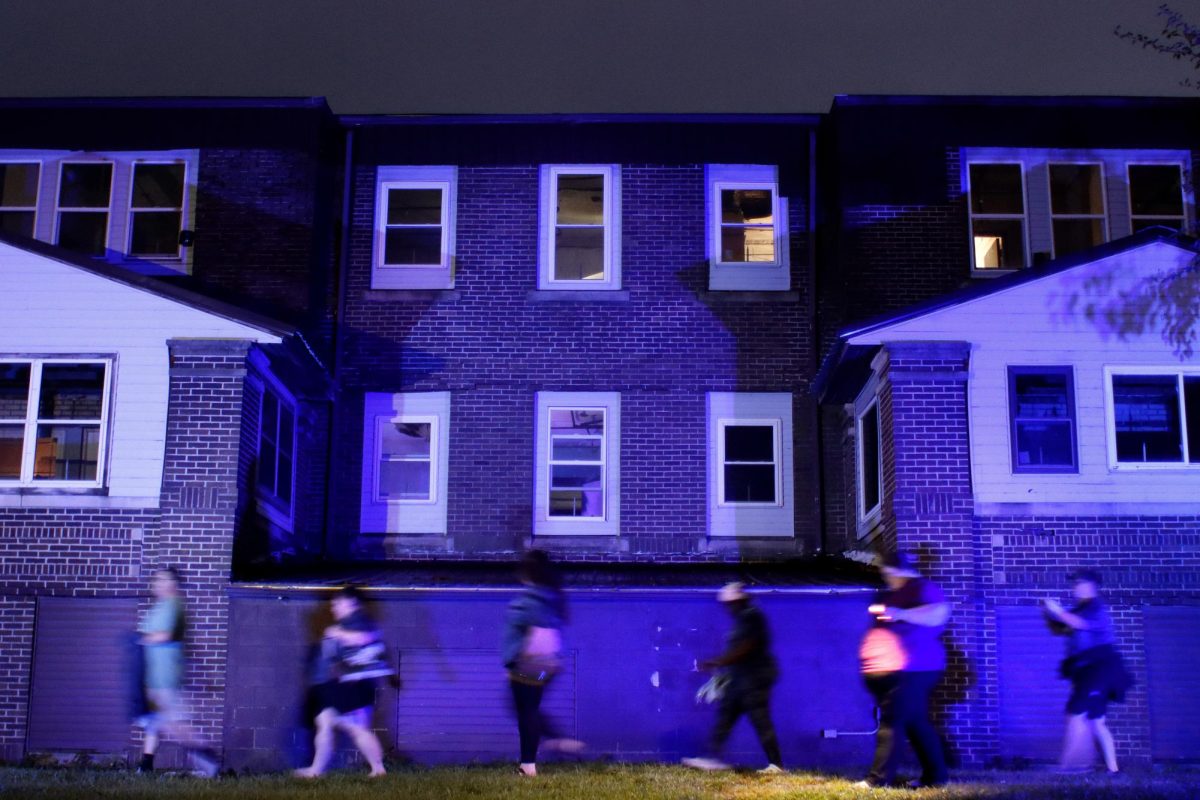




Students will inevitably pass by blue emergency poles dotted around campus as they brave the wind and snow blowing through the quads and between buildings.
Having been here for more than 20 years, the blue poles are meant to serve Eastern as a safety feature akin to that of a 911 call, according to University Police Chief Marisol Gamboa.
The poles are connected to Coles-Moultrie County 911 CECOM based out of Mattoon across from Sarah Bush Lincoln Health Center. When the button on the pole is pressed, the light on top turns on and a dispatcher from CECOM will be able to speak to and hear the user.
But of the 22 blue poles on Eastern’s campus, only 14, or two thirds, are still working, Gamboa said.
For the leftover eight poles, repairs aren’t an option.
UPD performs monthly checks to see if the blue poles connect to CECOM. If they don’t, UPD sends ITS a ticket, Gamboa said. From there, ITS takes the phone line offline to repair it, if possible.
“They’re old enough where it’s like we can’t call our local telephone company and say, ‘Hey, fix this phone,’” Executive Director for Information Technology Services Ryan Gibson said. “They’re not going to service that.”
The parts in the phone are so old that they have to replace the entire pole with updated technology, he said. ITS has not investigated the actual cost to upgrade the inactive poles at this time.
Last February at a student government meeting, Gibson said one to two of the blue poles go bad a month.
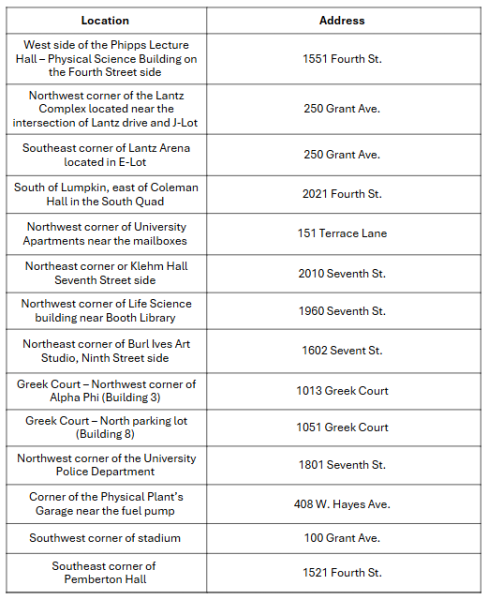
According to the EIU Office of Admissions – Admissions Ambassador Manual (Employee Edition), student tour guides are to pause at the blue pole near the Human Services Building in South Quad and tell those touring that they can press the button for help while continuing walking.
“Some clear advantages [are] that you’re not stuck at any one location,” said Gibson at the meeting last year. “You can have someone track you [and] it could be good or bad.”
However, using the poles properly forces the user to remain standing in one place and explain the problem. This isn’t exactly ideal in a scenario where one would have to keep moving, like if they were being chased or trying to escape a situation.
There’s no room for subtlety either, since the light on the poles start flashing when the button is pressed.
According to Gamboa, a more convenient device has the same function and is considered more trustworthy in situations like these: a phone.
Cell phones have an SOS call option that performs the exact same call function as the blue poles. The only difference is it’s actually mobile, so callers can stay on the go if necessary. Cell phones are also easier to trace, Gamboa said.
Perhaps this is why in the last 20 years, only one legitimate call has been made from a blue pole, according to Gamboa. Any other calls made on these blue poles were deemed illegitimate by UPD.
The tour manual also says there are 25 blue poles around campus, not the correct figure of 22 given by Gamboa.
Regardless of if someone activating the blue poles speaks or not, an officer will be sent to the location. That is an upside and in theory could allow the poles to be used while moving, as advertised.
But what if the next blue pole is a broken one? There’s a little above one in three chance, after all.
While the presence of the poles can act as a crime deterrent, like dummy cameras in some businesses, these poles are providing both visiting and attending students with a false sense of security.
In February 2013, the Daily Eastern News reported EIU spending $20,000 to replace most the emergency poles. Given the state of the poles and the university asking for feedback at student government last year, the time is likely nearing to make this investment choice again.
It’s time we stop pretending the blue emergency poles in their current state are for anything more than show. They have no practical use for those on campus and haven’t been used often enough to make them an effective safety measure for students.
It is definitely time to take them out of or at the very least update the tour manual.
There are two options for these things moving forward: either get them all up in running again quickly, likely at a high cost, or remove them and put the funding toward something with a purpose beyond its looks.
Until something changes, the blue poles will remain just cold metal painted Panther blue promising safety rather than ensuring it.
The Editorial Board can be reached at 581-2812 or at [email protected].