



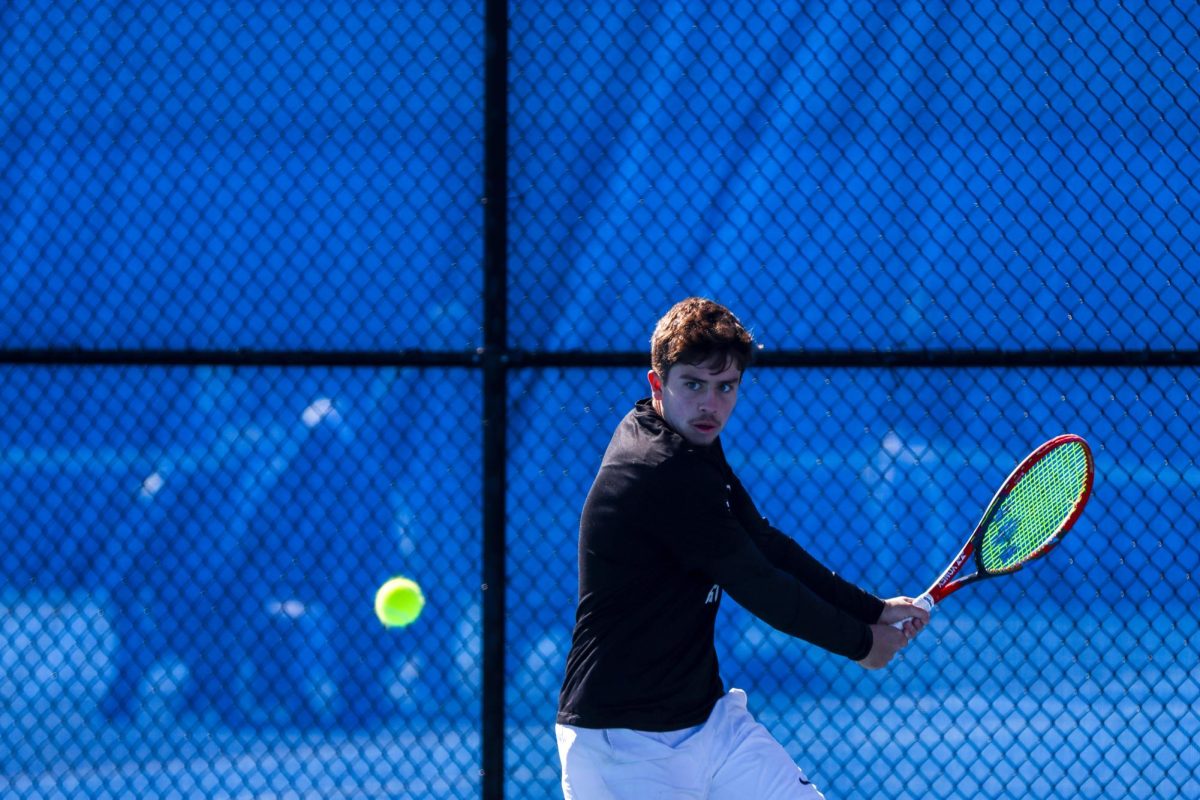









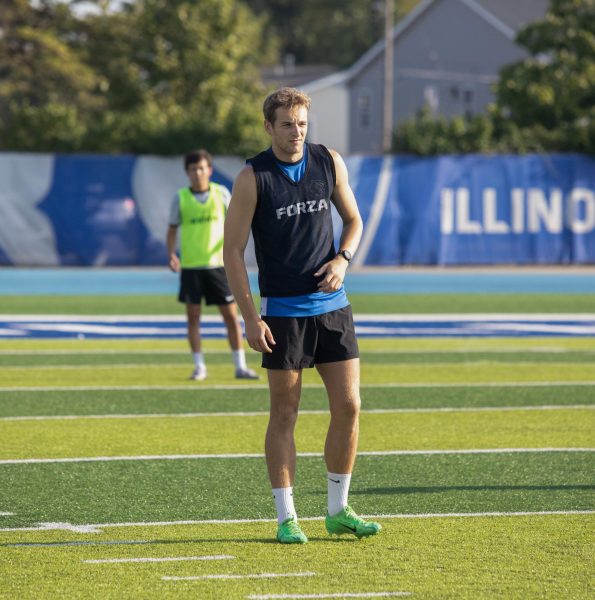
Sam Eccles vividly recalls spending soccer game after soccer game sitting on the substitute’s bench and watching the minutes tick by, wondering if he ever should have moved to the U.S.
He remembers watching once or twice a week. Sometimes he was caught in the rays of the August midday sun or shivering in the chilly October evenings as his team pushed the ball forward.
He recalls seeing the striker receive a pass, thinking to himself, “That should be me. I could have scored that chance. I could be the difference.”
Eccles had only played 161 minutes of soccer in two years at Hofstra University, a school on Long Island, New York.
The mental struggle of not picking up minutes was becoming too much for him.
Having left his entire life—family, friends and a confirmed place at the well-regarded Loughborough University back in England—in pursuit of a college soccer career, Eccles was seriously considering abandoning his dream in favor of the more-comfortable option back home.
“It definitely took a toll mentally,” Eccles said. “After my second year I was ready to go home. It’s hard when you’re not playing because you’re here to get an education but here to play soccer as well.”
Today, life could not look more different, with Eccles sitting on the bench alongside the team for a much more important reason- he now takes on the role as a player development coach for the Eastern men’s soccer team.
At 18 years old, the son of two physical education teachers was playing what he calls “football” in Sheffield, England, when he received an offer that would change the course of his life.
A friend of his coach in England came to watch Eccles play at the county level in a match where he scored four goals
That friend happened to be Richard Nuttall, the head men’s soccer coach at Hofstra.
“They needed a striker, and chance would have it he was coming home to visit family,” Eccles said. “He came and watched a game, I was lucky enough to score four [goals] that night and he and his assistant coach offered me a scholarship to play in the States.”
The decision to move halfway across the world wasn’t easy. Having already confirmed his place to study at Loughborough University in England, Eccles had to weigh up the risks, and the thought of leaving his family behind was difficult.
“Moms don’t like seeing their lads go away from home,” he said, noting the many conversations he had with his parents before accepting the offer. “But ultimately, she thought it was too good of an opportunity not to go.”
His father agreed. Eccles said they had always toyed with the idea of him playing abroad if his route in England’s highly competitive academy setup didn’t go to plan because of the opportunity college soccer offered to balance sport with education.
“I think it was maybe my dad’s dream that I would come and play in the States,” Eccles said. “Not because he doesn’t like me, but because he thought it was a great pathway. He was always saying education comes first before soccer, so this was the perfect situation for him, really.”
Eccles had to navigate travel to the U.S. during the height of the COVID-19 travel restrictions.
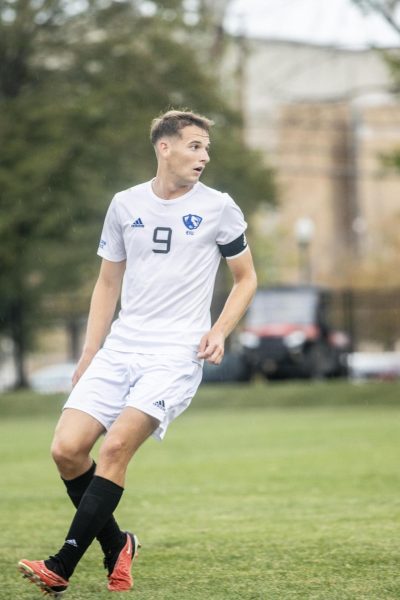
Once he managed to get into the country, he said he found himself in a “completely alien” environment not only as an immigrant but as a much younger player than those around him.
“It was tough. Really tough,” he said. “It was difficult enough adapting to the style of the game, and then you’ve got the added pressure as an 18-year-old coming into a team of 21 and 22 year olds.”
It was in joining the team at Hofstra that he formed a close friendship playing alongside Archie Watts, a goalkeeper from Bristol, England, the two growing a kinship over their shared feelings of being an outsider and a freshman in the U.S.
Watts said their relationship meant they had each other rely on during a turbulent time in the U.S. due to the pandemic.
“It was stressful trying to find out how to get there with all the restrictions, and the college soccer experience was very different from what I expected during that first semester,” Watts said. “But, it definitely made the process easier, for me at least, having Sam [Eccles] there. You had someone to relate to straight away. It made an unfamiliar situation feel a lot more familiar.”
In the two seasons at Hofstra to come, Eccles would never play more than 27 minutes in a single game. He grew increasingly frustrated and mentally torn at the lack of opportunity.
“After my first year, I worked really hard in preseason,” Eccles said. “I was like, ‘This is going to be my year,’” Eccles said. “I came back fit and strong, but then last season’s striker came back and I didn’t get minutes. My second year was rough, definitely mentally.”
Watts, similarly, did not play a single game for Hofstra and transferred to Upper Iowa University in 2022—the same year Eccles took a gamble in the transfer portal.
From the portal, Eccles was picked up by Eastern’s head coach at the time, Ronnie Bouemboue. It was a relief for Eccles, until Bouemboue left the team before Eccles officially joined.
Luckily for Eccles, new head coach Josh Oakley was keen to take Eccles on board, and under his coaching, the Englishman saw some of the most successful play of his career.
The uncertainty of whether he’d even make it to Eastern cast yet more doubt in Eccles’ mind, as he had only decided to stay in America to see out his education.
“It was a bit random, from Long Island, New York, to Charleston, Illinois,” he said. “But after doing two years out of a four-year degree, I thought I’d stick it out.”
Once settled as a Panther, Eccles went from not registering a single goal or assist in two years at Hofstra to 11 goals and seven assists in his three-year Eastern tenure.
Eccles started in all 16 games in his debut season under Oakley, later making the all-Ohio Valley Conference second team of the season in 2023 and earning the OVC Academic Medal of Honor the following year.
P.J. Allen played alongside Eccles during his years under Oakley and joined the coaching staff in 2024. He says he saw a unique quality in Eccles to raise the standard around him.
“He made me and a lot of others a better player,” said Allen. “We’d come up against each other in training, and he’s a kind guy, but on the pitch, you wouldn’t know it. When it came to practice and games, it was business.”
Following his success both as a player and as the captain of Eastern, Eccles had an agreement in place with Oakley to work as his graduate assistant following his last year of playing eligibility.
Oakley’s sudden departure in February 2025, however, once again left Eccles’ future in what he called a gray area, and he turned away from soccer to work as a graduate assistant in chemistry, which he had previously been doing alongside playing.
A chance conversation with the Panthers’ new coach, Ruy Vaz, at a training session Eccles volunteered at then steered him back into the sport at the very last minute.
“It was my first time meeting Ruy [Vaz], and I really liked the way he plays—very similar to the way I played growing up,” said Eccles. “I really liked his attitude toward player development and how he can get the best out of people to fit his system.”
Eccles said Vaz found his insight useful, having captained the squad for the last few years, and Vaz offered him a role as a player development coach.
“[Eccles] helps with developing training drills, running some of the drills and supports me during the game as well,” said Vaz. “I decided to bring Sam on to the coaching staff because of his past leadership status in the team, his experience at the Division I level, and the respect he has from current players.”
Since he was the captain, the transition from a player to a coach was easier, said Eccles, because a lot of the leadership qualities translated well.
“Coming from England and playing in a top academy system, Sam sees the game differently,” Allen said. “Since he was a captain last year, the guys who played with him know that he knows his stuff, so when he gets loud the guys know he’s not playing.”
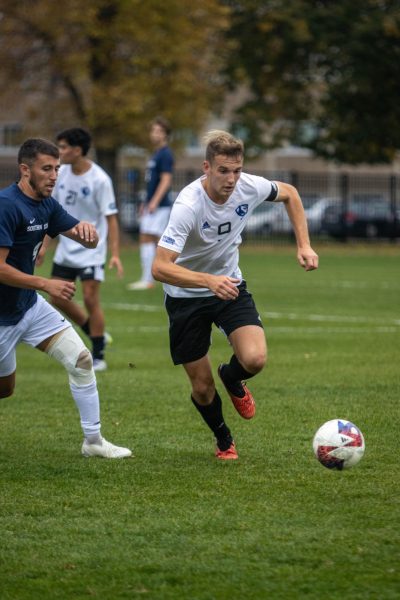
Reflecting on his new role, Eccles said he feels frustrated that he couldn’t see the game through the lens he sees it through now as a coach, and that he would have been a better player if he had looked at soccer from this different angle.
Though, he says, his new perspective on the game means he can pass advice on to the squad.
“All the mistakes I made as a player, I can relate that to the [current team] and help them out as much as possible, especially on the mental side of things,” said Eccles. “So many guys who don’t make it, who are talented on the ball—it’s all mental.”
As an international student who experienced the external pressures of culture shock, legal residency requirements, and homesickness made worse by a lack of game time, he says, Eccles felt as if he could offer a guiding hand to an Eastern team that brought in 16 players of which are from abroad.
“You understand the position these guys are in, coming from all over, different cultures, being thrown into a team and only having three months to gel as a group and produce results,” he said. “It’s taken a bit of time, but now we’ve seen them really come together as a group, which in my position is really good to see.”
With his visa extension earlier this year granting him another five years’ right to live in the U.S., Eccles is currently searching to study for a Ph.D. in chemistry and looking forward to marrying his fiancée, Claire Perez-Korinko, whom he proposed to in March.
Ethan Vine can be reached at 581-2812 or [email protected].


