














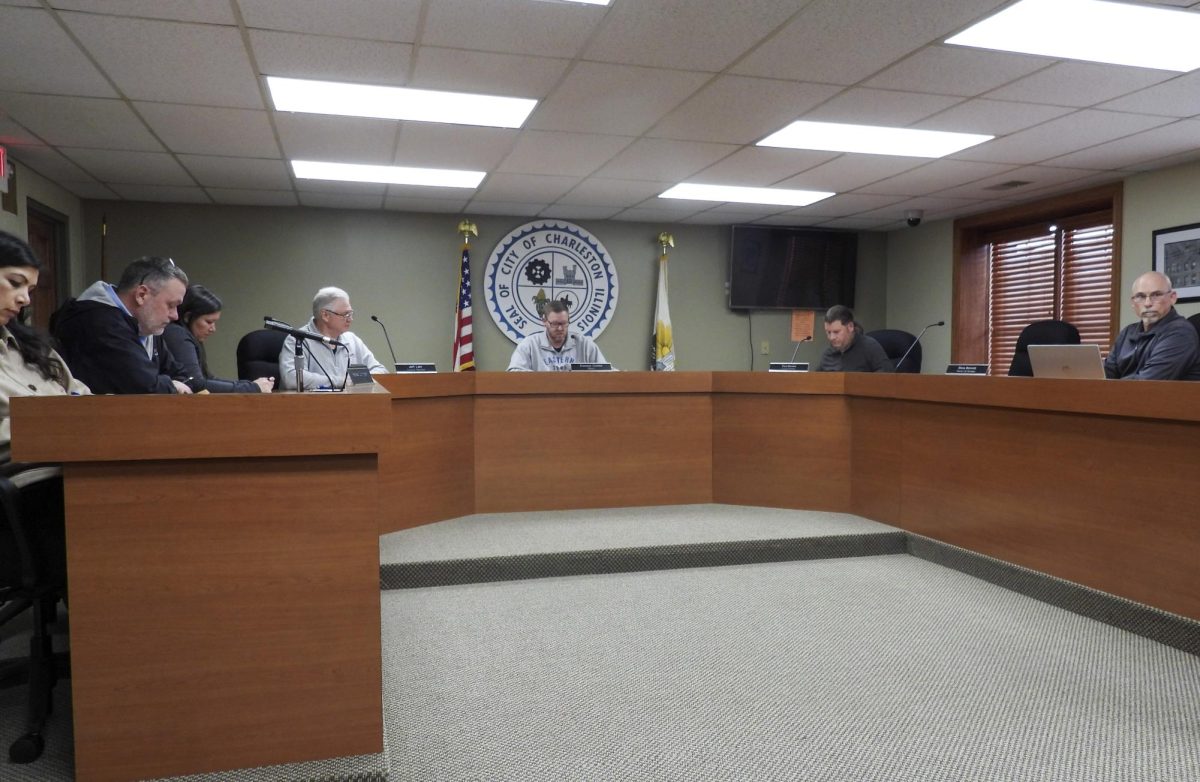
The Charleston City Council approved seven resolutions, three of which were related to the police department, at its meeting Tuesday.
The first resolution related to the Charleston Police Department saw the Council accept a bid from Pilson Auto Centers for three new police vehicles.
According to the resolution, the city will purchase two 2025 Dodge Durangos and a 2025 Ford Explorer. The total cost for the three vehicles is $119,879.
The resolution also deemed three vehicles as surplus to be traded in to Pilson. Those vehicles are a 2018 Ford Explorer designated as a K9 unit, a 2022 Ford Explorer and a 2023 Dodge Durango.
The combined trade-in value of all three used vehicles is $21,700, which is reflected in the total cost of the three new vehicles, according to the bid tabulation sheet.
The second CPD resolution approved the city’s 2026 towing policy, which will be put into effect on April 21.
The city maintains a list of wrecker companies that are called by CPD when a tow is needed. To be on the list, a company must have two wreckers and storage within Charleston.
The list is rotated weekly. Combs said there are two companies currently on rotation: Bartley Garage LLC and 1st Class Wrecker Service LLC.
The third CPD resolution approved an agreement between CPD and the Eastern Illinois University Police Department. The agreement allows UPD to use Charleston’s fingerprint machine.
The agreement runs through Dec. 31, 2026, but it can be automatically extended for up to 10 years.
According to Charleston Mayor Brandon Combs, the two departments have had a similar agreement since 2018.
The agreement has UPD pay a fee of $1,250, or half of the total cost of maintenance fees, according to Combs.
In addition to the three resolutions related to CPD, the Council also passed four others.
A resolution approving a temporary street closure on April 28 for food trucks on a section of the alley to the west of Marty’s was passed during the meeting.
A resolution supporting the nomination of opportunity zones by the state was also passed.
An opportunity zone is an area designated by the U.S. Treasury Department that gives access to federal tax incentives. The Treasury Department can designate an area as an opportunity zone following a nomination from a state governor.
The Council passed a resolution entering an agreement with the Illinois Department of Transportation to allow the city to sweep state route roads within Charleston.
According to Combs, the city would use its own equipment and personnel, and the agreement would have IDOT reimburse the city for the costs.
The final resolution moved a future City Council meeting scheduled for Nov. 3 to Nov. 4 due to the election.
The Council also approved the public display of two proposed ordinances that would amend ambulance rates and sewer and water rates. Both ordinances were tabled until the next meeting to allow for public review and comment.
Basic life support, which encompasses early-stage care such as CPR, would be billed at $993 compared to the current $902, and advanced life support would be billed at $1,444 compared to the current $1,312.95.
Both care levels would also include a transport fee of $20 per mile. The current transport fee is $19 per mile.
According to Combs, the rates are increasing due to rising costs.
The fees would increase 3% each May, starting in 2027.
For calls that do not require transport, the billing would remain at the same rate of $175 for ALS.
A third medic fee of $75 for out-of-town transports and a $500 non-resident extrication fee would also stay the same.
Non-emergency standby services would be billed at $195 an hour, going up from the current $150.
The city charges monthly service fees for sewer and water use.
The price of sewer and water service for those in the city’s corporate limits, excluding EIU, is currently $18.99 per 1,000 gallons. This would rise to $19.75 per 1,000 gallons.
Those using over 10,000 gallons are charged a reduced rate of $18.27 per additional 1,000 gallons. This would rise to $19 per additional 1,000 gallons. EIU is also on this rate for all of its water usage.
There is a separate fee for users within the corporate limits who use city water but do not use the sewer system.
For those using 10,000 gallons or less, there is currently a charge of $17.10 per 1,000 gallons. This would increase to $17.78 per 1,000 gallons.
Those using over 10,000 gallons are currently charged at a rate of $16.34 per additional 1,000 gallons, and this would rise to $16.99 per additional 1,000 gallons.
Jason Coulombe can be reached at 581-2812 or at [email protected].

