
















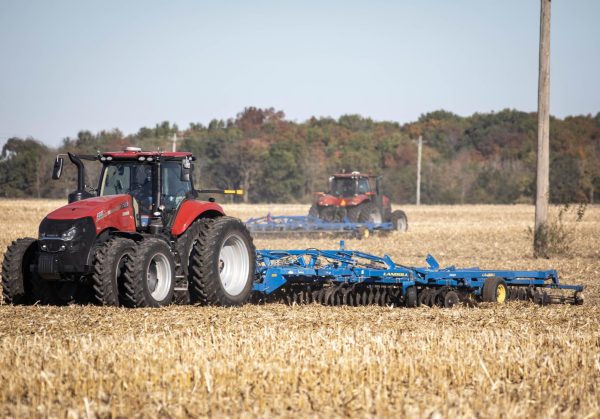
The dust billowing out from under Kyle Coffey’s tractor is not a sign of alarm. In fact, it’s a sign that everything is operating normally, even amid abnormal times in U.S. agriculture.
Coffey, a local farmer, was tilling his field for next year’s planting season. He farms a little under 4,000 acres across Coles, Douglas and Edgar Counties. Like many other central Illinois farmers, soybeans make up about 50% of his crop.
Harvest has been wrapped up for weeks now. His soybeans are in storage, and most of them will be transported to Decatur for processing.
But the question is, where will they go after that?
The top importer of American soybeans has gone quiet. China, who imported $12.6 billion worth of soybeans from the United States last year, hasn’t purchased a bushel since May.
Illinois farmers have been through this before.
During President Donald Trump’s first term, a trade war dampened American soybean exports to China. In January 2020, both countries signed a trade agreement that ensured China would buy American products, including soybeans.
In return, the United States would loosen regulations regarding foreign investments, among other concessions.
“In agriculture, we’ve come to realize we’re a pawn,” said Coffey. “A lot of sectors in our economy are pawns in the world trade market. It’s nothing new to us. My job on my farm is to mitigate risk.”
Earlier this year, China issued a retaliatory tariff on American soybeans in response to American tariffs. This made soybeans too expensive for buyers in China, according to the American Soybean Association.
“That puts our farmers at an untimely competitive disadvantage,” said American Soybean Association President Caleb Ragland in a letter to President Trump.
American soybeans are competing with South American crops from countries like Brazil and Argentina, who have jumped to fill China’s demand for soy in America’s absence. Brazilian soybeans filled 85% of China’s September needs—10.96 million tons, according to Agdaily.
Pricier American beans are already at a disadvantage on the global stage. Todd Main, who is the director of market development at the Illinois Soybean Association, noted that South America has lower costs of input.
Therefore, South American farmers can get land and seeds at a lower price than Americans can.
The American Soybean Association has been pressuring Trump to make a deal with China, something that Ragland hopes will happen Thursday.
A closing window
Trump will meet with Chinese President Xi Jinping on Thursday to discuss a trade agreement. Trump said on Oct. 22 that he expects to reach some sort of solution to the soybean issue.
Coffey said that the clock is ticking because the South American harvest happens in early spring.
“The biggest issue, I think, is that we’re running out of time,” said Coffey. “Our sales window is rapidly closing to where China does have other options.”
China effectively halts its U.S. soybean orders as soon as Brazil’s harvest hits in February, according to the American Soybean Association.
From February on, China will buy South American soy until it runs out, usually around September. After that, China is effectively forced to buy more expensive American soy because there are few alternatives.
As for this year’s crop, if it isn’t sold, it may take until next fall to sell.
“[China] could throw us a bone and work something out, possibly in the next 30 days,” said Coffey. “Because obviously, China has an interest in our economy as well. They need beans, and we know they need beans, and they’re just playing hardball with the beans.”
China has invested heavily in diversifying where they get their soybeans from, according to the American Soybean Association.
South American farmers do not need to make as much money off of their crops in order to still be profitable. This is because their costs of production are lower than in the United States, according to Main.
In September, Argentina waived taxes on its soybean exports. China, in two days, purchased 20 shiploads of soy from the country, according to the American Soybean Association.
Two ways forward for farmers
Main presents two outcomes:
“There’s the best-case scenario that could happen, and there’s likely what will happen,” he said. “The best-case scenario is that there would be an agreement with China, and we could sell our beans to China, and they could have beans to feed to their animals and people.”
Main said that the likely scenario is finding alternative markets for U.S. soybean exports in the short term. In 2024, 23% of U.S. soybean production went to China, according to Purdue University. That’s a little more than half of all American soybean exports that year, according to the USDA.
This is a “pretty big chunk,” said Main. It’s unlikely to find other markets that could cover for China, he said.
In the meantime, Trump proposed a $10 billion bailout to those soybean farmers who are affected by the trade war. He did the same during the last trade war, when he passed a $16 billion bailout to affected farmers.
The idea of a bailout has been met with mixed reception.
“We’re not bailout people,” said Coffey. “We just want free markets to function.”
Brad Daugherty, a farmer from Clark County, commented as well.
“Farmers could use the bailout, but the bailout isn’t the answer,” said Daugherty. “It never is. All we want is our exports back. If we can get our exports, our market will come back.”
Illinois will be affected less
The state of Illinois is positioned well to avoid the fallout of China’s embargo, according to Vice Chairman of the Illinois Soybean Association Brady Holst. Illinois soybeans are often shipped down the Mississippi River and exported out of the Atlantic Ocean and Caribbean Sea.
Columbia, Egypt and the European Union purchase Illinois beans because of the river access, according to Holst.
Up in North and South Dakota, it’s a different story. Holst said that their soybeans are loaded onto trains headed to the Pacific Ocean. Most of their soy typically goes to China.
China pulls in about half of America’s exported soy while the European Union takes in about 10%, according to 2024 data from the USDA.
Even with diversified buyers, Illinois farmers still sell to China. Holst, a farmer from western Illinois himself, said many people are a little antsy at this point.
“I think people are starting to get kind of nervous about it,” said Holst.
Coffey, on the other hand, is optimistic.
“We knew it was coming, and we just try to plan accordingly,” said Coffey. “It’s just like the weather, the variables that are sort of out of your control. You still try to mitigate those risks.”
Aidan Cusack can be reached at 581-2812 or at [email protected].

