Editor’s Note: This story is part of a Day in the Life of Charleston series.
Todd Foster arrived at the Charleston Area Churches Food Pantry at exactly 8 a.m. on Nov. 14.
The pantry was in the process of taking ownership of the property from Habitat for Humanity, another charitable organization that previously owned it.
Two weeks away from closing the sale, Foster said that the pantry had been in a state of limbo. With Habitat already having relocated, the pantry needed to make decisions on a building it legally didn’t yet own.
Managing this dilemma has been one of Foster’s many jobs as the director of the pantry, where he has volunteered since 2008.
Between 1990 and 2020, Foster spent decades as a firefighter/paramedic in Charleston, working across two stations and managing 11 staff as a fire captain in his later years.
“In the fire service, when somebody calls you, they’re having the worst day of their life. Their house is burning, their loved one is dying, they’ve been in a car accident — something horrible has happened and you’re there to comfort them,” Foster said. “Here, you get to comfort them often, on a regular basis, in an ongoing crisis rather than an immediate one.”
An ongoing crisis is what Foster and the other volunteers at the pantry experienced over those last three or four weeks.
When the federal government shut down on Oct. 1, the 42 million Americans who rely on Supplemental Nutrition Assistance Program benefits, formerly known as food stamps, were plunged into unpredictability.
The 1.9 million people in Illinois who pay for groceries using an Electronic Benefit Transfer card were affected unevenly by the shutdown; some, Foster said, lost all their benefits; others lost little or none at all.
The only certainty has been uncertainty.
“What we have seen lots of is anxiety and panic, and we don’t know what’s going to happen,” said Foster. “So, what we’ve had to adjust is more volunteers, more hours for the volunteers, more time shopping and restocking shelves.”
This extra time and money spent shopping has been manageable short term but will be economically unsustainable in the long run, he said.
Todd noted that when the Charleston Area Churches Food Pantry first opened in 1985, eight local churches combined their missions to better allocate resources. At one point, 26 different churches regularly contributed either finances, volunteers or board members. In 2025, just five churches serve the pantry.
Foster said the churches have had to “tighten their belts in the current economy” and think more carefully about where they distribute their help.
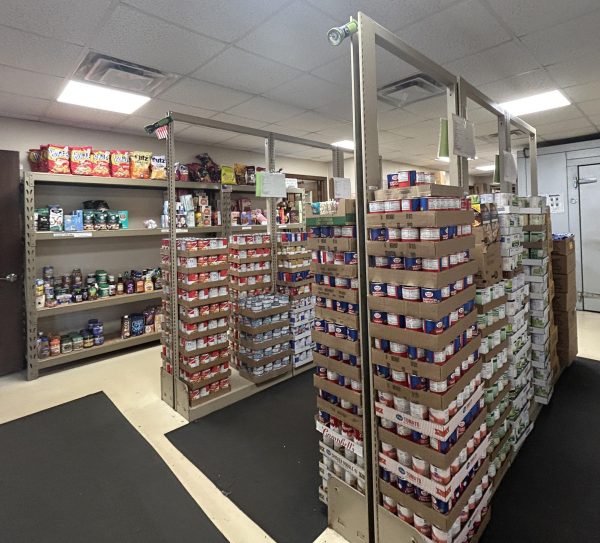
On Nov. 14, the pantry was an open space littered with shelves and stacks of various preserved goods, cans of everything from mushroom soup to tinned sweet peas, piles of bags of rice and stacks upon stacks of cereal boxes. The foods were labeled with a variety of brand names: some Walmart, some Ruler Foods and others Cheerios or Campbell’s.
The brand name doesn’t matter, said Foster. His guests were just happy to eat.
To Foster, the people who come to the pantry are not visitors. Instead, they are guests. This is because they can return only once every 30 days, which is the limit for families or individuals wishing to use the pantry, and as guests, they are most welcome.
Foster said that the most rewarding part of the job is seeing the shift in demeanor of his guests. The first time they make use of the pantry, their heads are often low, Foster said, and they may feel ashamed for taking what many at first consider to be handouts. He said it’s the responsibility of him and his staff to make the experience positive so that the guests don’t feel guilty when they come back.
Before guests can arrive for the pantry’s opening hours, which are 1:30 p.m. to 4 p.m. every Monday, Wednesday and Friday, there’s plenty of work that goes on behind the scenes.
Foster generally begins each open day by making stops at the donors across the city of Charleston, like Starbucks, Ruler Foods, Walmart and Insomnia Cookies. He said that the pantry’s policies allow them to distribute food anywhere up to a year past the date on the packaging.
Foster said this is the difference between perfectly good food going to waste and hundreds of families a month being able to put food on the table.
On Nov. 14, the would-be-wasted food from Walmart alone totaled 638 pounds. The math was simple enough, said Foster. With one pound equivalent to a dollar’s worth of food, that’s $638 salvaged to feed people in a week.
Foster’s desk, located in his office adjacent to the pantry, was strewn with papers and a box of 20 cleaning sponges that he planned to distribute to guests and other local services. The walls were the same tan color as the rest of the building, and there was a decal on the left wall reading, “Nothing is impossible to a willing heart.”
“The crux behind it is loving your neighbor as yourself,” he said. “That means if they’re hungry, you feed them. If they’re naked, you give them clothes. If they’re crying, you hug them [and] you pray with them. You make them feel human.”
Foster said that there are many other services intended to support those in need and that the general public is often unaware of them.
One of these services is the Standing Stone Community Center, which sits in the northeast part of Charleston and has a very close connection to the pantry.
“It isn’t a competition, our relationship,” said Dawn Thomson, the center’s manager and executive director. “If I can’t help you, I’ll direct you to someone who can.”
Standing Stone will point customers in the direction of the pantry, and vice versa. When he has excess stock, Foster will donate it to help with Standing Stone’s mission.
Standing Stone works in a very similar way to the pantry. Having opened in June 2011, it relies on donations of clothing and furniture, and guests can take five free items of clothing every 30 days. Clothes and furniture can otherwise be purchased for heavily discounted prices, and the profits are then reinvested into Standing Stone’s own miniature food pantry.
Foster has invested a lot of time into building these kinds of relationships with the community.
On one occasion, someone donated 5,000 cartons of crayons, Foster said. Because the crayons were of no use at the food pantry, Foster chose to donate them to local schools.
Another time, a dog food truck overturned in Urbana. Foster made the connection with the Charleston animal shelter that shared the food with six other shelters in neighboring counties.
In his retirement, Foster also runs a homeless shelter alongside the pantry. He said that the “transitional housing opportunity” is different than a typical shelter.
Located in what was previously a roadside motel, the shelter’s 16 rooms are available free for six months to those who have nowhere else to stay on one condition: The occupants have to be making progress.
Foster said progress looks different for everyone. For some, it’s sobriety. For others, it’s reconnecting with their kids. For many, it’s finding employment.
Each resident creates a progress chart that must be followed alongside other rules to keep a room at the shelter.
The reason he does all of this work?
“God made me to be a helper,” Foster said.
Foster has built a family of helpers, too. He and his wife raised children much of their adult lives. They have two daughters, ages 29 and 30, and one son, age 20.
Todd Foster’s wife, Vicky Foster, is a year away from retirement and works offering educational guidance by instructing other teachers in various schools.
His eldest daughter, Bailey Kiger, works at a children’s advocacy center, and her role involves testifying in court on behalf of children. His youngest daughter, Payton Augustine, is a special education teacher in Charleston. Nick Foster, his son, is frequently involved in volunteer work at the food pantry.
Back at the pantry, the first of the volunteers began filtering in around 1 p.m. on Nov. 14. Ever since the uncertainty surrounding the future of SNAP benefits, more members of the community have offered to step up and contribute to Foster’s existing volunteer staff of 30.
Each day usually has six or seven staff, and the pantry can serve up to 60 families in that time. The pantry is open for two and a half hours on a given day, which only gives the staff two and a half minutes with each guest.
During the check-in process for the pantry, guests must provide ID to prove they are Coles County residents and to confirm that they are not checking in sooner than the 30-day period allows.
Diane Eckert, who worked the desk on Nov. 14, said her job is the toughest when she has to turn guests away that arrive before the 30-day period ends. It’s awful, she said, but it’s fair.
Eckert has been on the board at the pantry since 2012, and she also volunteered elsewhere with her parents as a child.
“I always had a good feeling sending people home with food to eat,” Diane said. “Just knowing I can help someone not be hungry is a good feeling, and so I love to do my part in that way.”
Once Diane checked in a guest, two items from a wall of “luxuries” were chosen, including large packets of chips and bags of coffee beans to cake mixes, hot sauces and cookies.
In the meantime, the volunteer packers began putting together a pre-built box of food items to be distributed. The shelves in the back of the pantry were already filled with these, and family sizes one to six were eligible for one box, and family sizes any larger were eligible for two boxes. It was the packer’s role to replenish the supply of boxes as the orders came in.
Helen Hendren, who has volunteered at the pantry for upward of 10 to 12 years, took on the packing role on Nov. 14. She started at the pantry while teaching at Lake Land College.
“I thought, ‘You know what, if I’m going to encourage my students to do that, I need to walk the walk,’” she said.
When Hendren’s packing was done, a volunteer puller gathered the box, added an additional choice of meat and a dessert dish that was selected by the guest, and then put the box on a cart for another volunteer to take out to the guest.
The intersection of different roles ran like clockwork. As soon as a guest was recorded in Foster’s logbook, the cart was compiled, and the packers swiftly replaced the space left on the shelf.
It was a conveyor belt of cardboard, and approaching 4 p.m., the line outside had dispersed.
In September, the pantry donated 11,826 meals to guests, feeding 383 families.
By the time the pantry closed on Nov. 14, Foster said 40 families, or 105 individuals, had been served in one day.
Foster ended the day by returning to his home, wife, son and two dogs, Lily and Daisy, feeling a sense of purpose far greater than if he had spent a day of retirement golfing, fishing or hunting.
Ethan Vine can be reached at 581-2812 or [email protected].